The diagnosis
Record AI adoption, the same old metrics, and where a tester’s time goes.
State of Testing 2026 · The 70% problem
Record AI adoption, same old metrics
Chapter 00 · The diagnosisState of Testing Report 2026, by PractiTest and Tea-time with Testers.

The industry upgraded its tools but not its thinking. We are still in the test factory, measured on pass and fail, rewarded for volume rather than value.
Source: State of Testing 2026. 56% of teams are measured on test coverage.
Clerical burden
- Documentation and artefact management
- Repetitive analysis and reporting
- Automation maintenance
- Status updates and test reporting
- Gathering insights from failing tests
Expert work
- Critical thinking and risk judgment
- Testability assessment
- Deep exploration
- Context analysis
- Strategic testing
The 70/30 split is Lalit’s own observation across teams, not a published figure.
Quality Conscious Software Delivery
Where QCSD came from, what it is, what it changed, and what it costs to run by hand.
Origin · What QCSD is · Five phases · Outcome · Cost of rigour
Where QCSD came from
Chapter 01 · Born out of necessityA real delivery team, a real product, and a backlog that kept growing faster than the team could ship.

What the team was living with
What QCSD is
Chapter 02 · Quality Conscious Software DeliveryDelivery of quality products by quality-conscious people using quality-empowering processes.
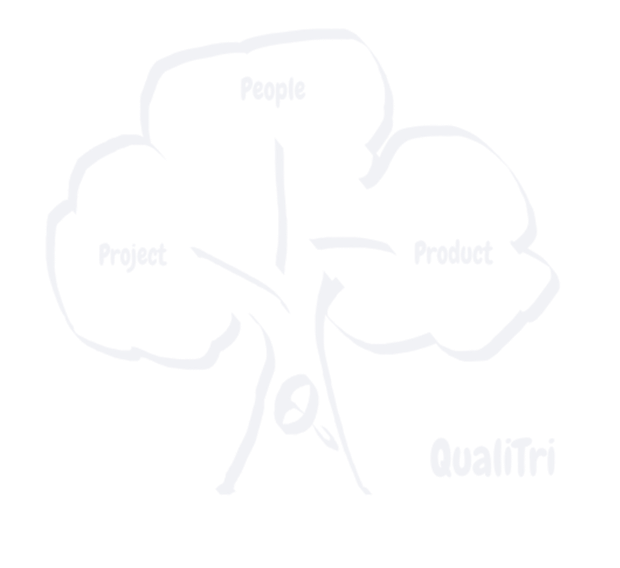
Quality is never the property of the product alone
- Products are built by people
- People work in projects and follow processes
- Project, people and product quality affect each other
Enable, Engage, Execute, Evaluate
Every build, feature, release and issue weighed against one business question
Increase test automation by 80%
Feature testers · API testers · central automation team · operations
Automate build-qualifier scenarios · support CI pipelines
Scenario lists · executable scripts · smoke-test pipeline · CI dashboard
The five phases
Chapter 03 · The frameworkQuality work placed at every phase of delivery, with a named session for each. Select a phase.
The outcome
Chapter 04 · Results, recognition, adoption- Reduced lead time
- No obvious bugs
- Nominal production bugs
- Less rework
- More features released per sprint
- More tickets pulled within the sprint
- Continuous discovery
- Continuous feedback
- Continuous quality
QCSD was awarded the EuroSTAR Software Testing Best Paper award in 2022. Read the paper
iFM engineering published its own case study of adopting QCSD.
QCSD has been applied across several Accenture client deliveries.
The cost of upfront rigour
Chapter 05 · Why not every team can do itQCSD works because it is always cheaper to do things right the first time. Doing them right the first time means putting skilled people in a room before a line of code exists. Add the sessions one feature needs.

- Senior people's time, repeated for every feature
- The first thing cut when a deadline moves
- Depends on a coach in the room to run it well
The cost, speed and quality trade-off
Chapter 05 · Why not every team can do itCost, speed, quality: pick two
Upfront rigour has always pulled quality up at the price of cost or speed.
Agentic QCSD and Designed Agency
Upfront rigour carried by AI agents, and the judgment designed into them.
Agentic QCSD · From session to swarm · The 70/30 split · Symptoms answered · Designed Agency
Agentic QCSD: QCSD power-charged with AI agents
Chapter 06 · Upfront rigour, carried by AI agentsSame goal, same people, same processes. AI agents make the upfront rigour possible, affordable and more intelligent.
Every QCSD session now has a swarm of AI agents that does the legwork for every story, in every sprint. People keep the decisions.
The rigour runs on every epic and every story, without waiting for a coach or a free afternoon.
AI agents gather, analyse and draft; people spend their time only at the gates that need judgement.
One shared knowledge graph learns from every swarm, every squad and every production incident.

Every knowledge worker holds one true part
- The PO, the architect, the developer and the tester each know a different part of the truth
- Agentic QCSD assembles those parts in one shared memory that every swarm reads
- Each decision is made with the combined truth on the table
From QCSD session to Agentic QE swarm
Chapter 06 · Agentic QCSDThe sessions stay. A swarm of AI agents does the preparation for every story, and people keep the decision.
How Agentic QCSD changes the 70/30 split
Chapter 06 · Agentic QCSDThe clerical 70% moves to AI agents. The expert 30% becomes the tester’s work at every gate.
- Documentation and artefacts→Phase reports drafted for every story
- Repetitive analysis→SFDIPOT and risk scoring on every story
- Automation maintenance→Tests generated from the test ideas
- Status updates and reporting→GO, CONDITIONAL or NO-GO verdicts with evidence
- Insights from failing tests→Root cause analysis and defect prediction
- Risk judgmentDecide which risks block the story
- Critical thinkingChallenge the verdict and its evidence
- TestabilityAsk for the change that makes it testable
- Deep explorationExplore where the AI agents did not look
- ContextBring the business and domain knowledge
Symptoms and the methods that answer them
Chapter 07 · Built by designSelect a symptom.
Agentic QCSD is built on Designed Agency
Chapter 08 · Designed AgencyThe industry adopted the word agentic faster than it examined what the word means. Designed Agency compels us to think about and define what it means in our context.
- An LLM decides the next step
- It calls tools
- It runs in a loop
- Encoding judgment without architecture is just a prompt
- Architecture without encoded judgment is just plumbing
- Without honest approximation there is no way of knowing whether what was built is any good
Judgment deliberately designed in by practitioners who know the work deeply enough to encode it, architect it and measure it honestly.
- Encoded the threads, the material the cloth is made of
- Structured the loom, the instrument that acts on the material
- Approximated the contact between threads that gives the cloth its texture
The three dimensions of Designed Agency
Chapter 08 · Designed AgencyThe three dimensions and how they show up in the AI agents. Select a dimension.
Further reading: Congratulations on your agent. Does it have agency? · Lalitkumar Bhamare on LinkedIn

The 70% Problem
Reclaiming Testing’s Intellectual Core with Agentic QCSD

 Lalitkumar BhamareDragan Spiridonov
Before we start
Your hosts, the run of show, your workspace and a warm-up exercise.
Your hosts · Run of show · Setup · Exercise 0
Who is running this room
Your hostsLalitkumar Bhamare
EMEA Lead, Quality Engineering Thought Leadership · Accenture Song
- Creator of QCSD, Quality Conscious Software Delivery. EuroSTAR 2022 Best Paper.
- Creator of Agentic QCSD. Key contributor to the open-source Agentic QE framework.
- Co-Founder and Chief Editor, Tea-time with Testers. Former VP Education, AST.
- Co-author, State of Testing 2026. Emerging QA Leader of the Year 2025.
Dragan Spiridonov
Head of Agentic Quality Engineering · Cognitum One · joining by video today
- Creator of the Agentic QE framework. Evolved PACT into PACTS.
- 29 years in technology, 12 of them building quality engineering functions in enterprises.
- Creator of the Agentic QE Fleet. Founding member, Serbian Agentic Foundation Chapter.
- Former programme chair, Belgrade Test Conference. Writes at forge-quality.dev.
Run of show
13:00–16:00Setup in your workshop workspace
13:00–13:10Codespaces runs on GitHub. DevPod runs locally through Docker. AI agent exercises use your own model access and tokens. Workshop repo: bit.ly/ttf-agentic-qcsd
devpod up . --provider dockeror open the repo in a Codespacebash .devcontainer/prepare-workshop.shbash .devcontainer/verify.shthennpm run test:run- Sign in to your AI agent inside the container.Trust the workspace, approve the AQE MCP server.
- Open LAB.md.Exercise 0 is already prepared: inspect its output.
git clone https://github.com/fndlalit/TTF-Agentic-QCSD-Workshopnpm install -g agentic-qe@latestaqe init --autonpm installaqe code index src/npm install -g @huggingface/transformers@4.2.0aqe learning import -i seed/aqe-seed-patterns.json
Node 22.13 or newer and npm 10+.
Clone near your home folder. Deep paths lose files from the graph.
Add --with-copilot, --with-cursor or --with-kiro.
Full guide: docs/DEVCONTAINER.md and README.md in the tutorial repo.
Warm-up: give the fleet a map of your code
Exercise 0 · 13:10–13:20About 2 minutes · in your terminal, not through your AI agent · no API key, no tokens
aqe code index src/
21 files · 102 nodes · 117 edges
aqe hg stats
Manual setup: 140 nodes · 102 edges.
Container: 110 nodes · 89 edges.
aqe memory usage
21 entries · 81 vectors, before you begin
Static analysis and local embeddings inside your workspace. No provider key, no tokens. In the container, prepare-workshop.sh has already run these three commands.
The engine
Swarm architecture, feedback loops, and the Agentic QE framework from its creator.
Architecture · The engine · AQE intro by Dragan
Swarm architecture and feedback loops
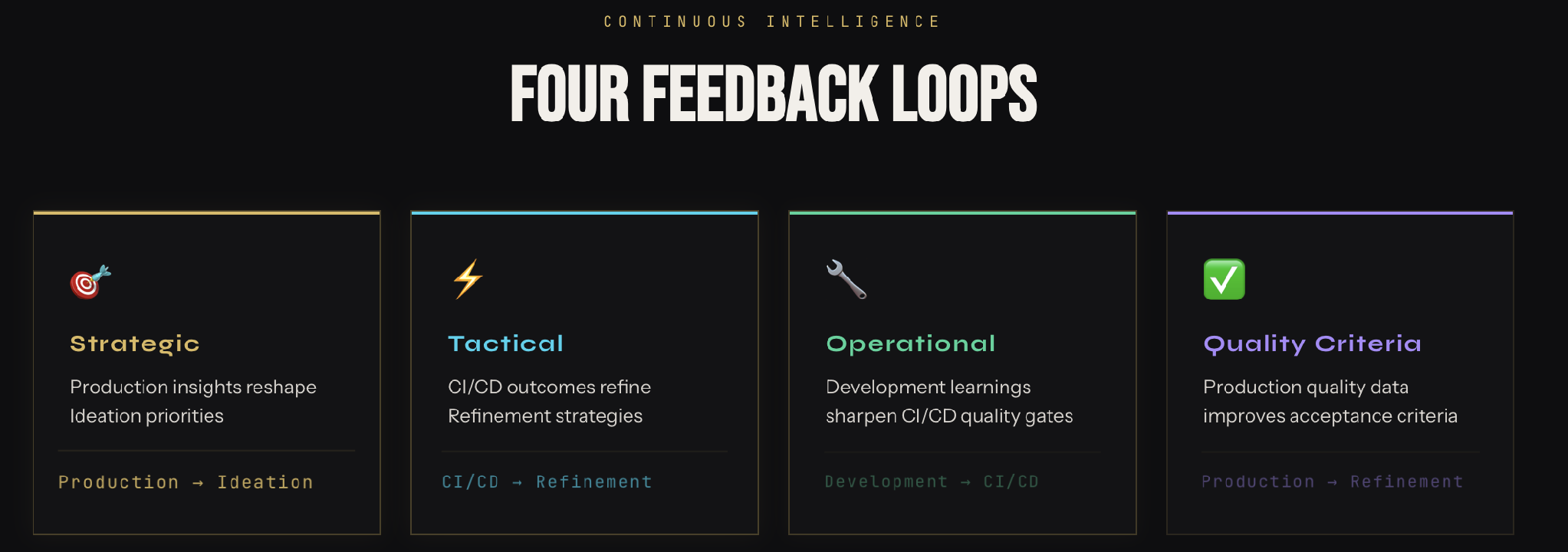
Architecture · 13:35–13:40Five swarms, one per phase, each handing its findings forward. Four feedback loops carry what each phase learned back to the phase that can act on it.
The engine that powers it all
Architecture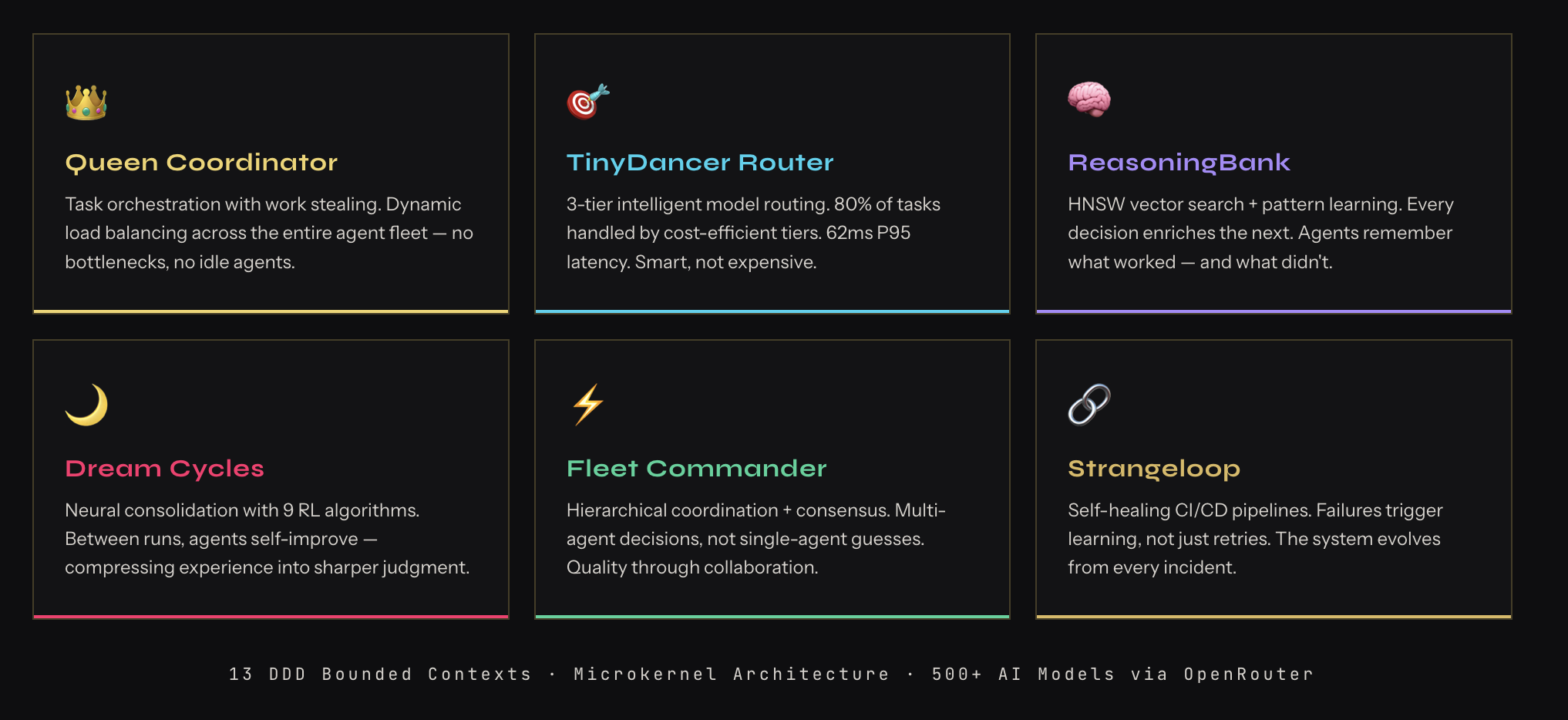
The Agentic QE framework, from its creator
AQE intro · Dragan Spiridonov · video · 14 minDragan Spiridonov · Head of Agentic Quality Engineering, Cognitum One · creator of the Agentic QE framework · github.com/proffesor-for-testing/agentic-qeHands-on lab
Five exercises on one checkout app, from the epic to the release call.
Ideation · Refinement · Development · CI/CD · Self-learning
 Ideation: surface risk before any code
Exercise 1 · Ideation · 13:55–14:20About 20 minutes · qcsd-ideation-swarm · installed as a skill, not a command file
/qcsd-ideation-swarm

Analyze the guest-checkout epic in requirements/epic-checkout.md, using requirements/user-stories.md and requirements/acceptance-criteria.md for context. Work from these files only, with no web research. Skip the security audit: Exercise 4 covers security.
Save all reports under reports/01-ideation-swarm/.
Save learnings and persist patterns.
reports/01-ideation-swarm/Two versions in LAB.mdRead the epic yourself. Which verdict would you give: GO, CONDITIONAL or NO-GO?
Your AI agent is signed in inside this workspace and the AQE MCP server is approved. Not on Claude Code? LAB.md has a step list.
Exercise 1 debrief
Last 5 minutes of the slot · in pairs, then the roomIdeation: surface risk before any code
Which verdict did you get?
NO-GO, CONDITIONAL or GO. Find it and its top blockers in the executive summary.
Which contradiction between the epic, the stories and the criteria did it find?
Check one against the files in requirements/. Is it real?
What would you refuse to start building without?
Show of hands on the verdict, then one blocker per table.
Open reports/01-ideation-swarm/
Our measured run (open after the debrief)
Measured on 6 November 2026, agentic-qe 3.15.18, Claude Code, unattended: 6.7 minutes, $2.25. Interactive runs take longer because you approve tool calls. Verdict in this run: CONDITIONAL, 39 risks (4 critical), testability 59%, requirements completeness 46%. The skill’s stricter threshold table would read NO-GO, and the report says so.
Coffee break
Back at 14:35. Keep the report from Exercise 1 open.
Next · Exercise 2 · Refinement: product factors before coverage
 Refinement: product factors before coverage
Exercise 2 · Refinement · 14:35–14:50About 10 minutes · qe-product-factors-assessor
Use qe-product-factors-assessor to analyse the guest-checkout product from requirements/epic-checkout.md and requirements/user-stories.md. Produce a product-factors (SFDIPOT) assessment and save it to reports/02-refinement-product-factors.md.
Save learnings and persist patterns.
reports/02-refinement-product-factors.mdTwo versions in LAB.mdWhich of the seven factors do you expect to carry the most risk here?
Structure, Function, Data, Interfaces, Platform, Operations, Time.
Exercise 2 debrief
Last 5 minutes of the slot · in pairs, then the roomRefinement: product factors before coverage
Which of the seven factors got the most test ideas, and which the fewest?
Structure, Function, Data, Interfaces, Platform, Operations, Time.
Which test idea would you not have thought of yourself?
Then find one that is generic enough to fit any checkout.
Which factor carries the real risk for this business?
One factor per table, with the reason.
Open reports/02-refinement-product-factors.md
Our measured run (open after the debrief)
Measured on 6 November 2026, agentic-qe 3.15.18, Claude Code, unattended: 3.3 minutes, $0.52. The AI agent produced 74 test ideas across the seven SFDIPOT factors, 23 requirement gaps and 11 ranked risks. It did not read the acceptance-criteria file, which is worth asking the room about.
 Development: tests for the highest-risk module
Exercise 3 · Development · 14:50–15:10About 15 minutes · qe-test-architect
Use qe-test-architect to generate a comprehensive test file for the payment-retry logic in src/lib/payment-retry.ts. Use the test ideas in reports/02-refinement-product-factors.md as input, and include property-based tests for the module's invariants.
Save the test file as tests/lib/payment-retry.architect.test.ts and a short rationale to reports/03-development-tests.md.
Save learnings and persist patterns.
tests/lib/payment-retry.architect.test.tsTwo versions in LAB.mdOpen src/lib/payment-retry.ts. Name one invariant its tests must hold.
This step reads what Exercise 2 wrote. Run them in order.
Exercise 3 debrief
Last 5 minutes of the slot · in pairs, then the roomDevelopment: tests for the highest-risk module
Do the generated tests run, and do they pass?
For a failing test, decide whether the test or the code is wrong.
Which invariants did the property-based tests choose?
Look for backoff bounds, retry limits and idempotency.
Are those the invariants that matter?
One missing invariant per table.
Run npm test -- --run tests/lib/payment-retry.architect.test.ts
Our measured run (open after the debrief)
Measured on 6 November 2026, agentic-qe 3.15.18, Claude Code, unattended: 3.0 minutes, $0.55. The AI agent wrote 74 tests, all passing, with fast-check property tests. One it.fails test documents that jitter is added after the delay cap. It also recorded that every thrown error is retried, even a card_declined code.
 CI/CD: verify, gate, decide
Exercise 4 · CI/CD · 15:10–15:25About 10 minutes · qe-queen-coordinator
Use qe-queen-coordinator to run a verification-only quality assessment of src/lib/payment-retry.ts (do NOT generate tests). Analyse coverage gaps with risk scoring, security-scan the module, apply a 90% quality gate, and give a GO / CONDITIONAL / NO-GO deployment recommendation with the top blockers.
Save the consolidated report to reports/04-cicd-quality-assessment.md.
Save learnings and persist patterns.
reports/04-cicd-quality-assessment.mdTwo versions in LAB.mdRead src/lib/payment-retry.ts. Would you ship it? Write down your answer.
payment-retry.ts is at 100% of statements and 97.29% of branches before Exercise 3 adds tests. After it, 109 of 109 tests pass at 100% coverage. Coverage alone does not make the release call.
Exercise 4 debrief
Last 5 minutes of the slot · in pairs, then the roomCI/CD: verify, gate, decide
Which recommendation did you get?
NO-GO, CONDITIONAL or GO. Compare the gate score with the coverage figure.
Did it report the missing idempotency key and the backoff cap applied before jitter?
Both are in the module’s source.
Would you ship it?
Show of hands, then what you would be willing to ship without.
Open reports/04-cicd-quality-assessment.md
Our measured run (open after the debrief)
Measured on 6 November 2026, agentic-qe 3.15.18, Claude Code, unattended: 1.4 minutes, $0.34. Verdict in this run: NO-GO with 109 of 109 tests passing at 100% coverage. Blockers: no idempotency key, no gateway timeout, every thrown error retried. The quality_assess gate call returned insufficient evidence, so the AI agent applied the 90% threshold itself.
 Self-learning: put the fleet’s memory to work
Exercise 5 · Self-learning · 15:25–15:35About 10 minutes · same prompt for every tool
Recall from AQE memory what the fleet learned about this checkout app across Exercises 1–4: payment retry, cart state, checkout form accessibility, and request validation.

First list what you recalled: each pattern's name and one line on what it says. Then consolidate that into a one-page brief (top risks, testability gaps, contradictions, and the release verdict), framed as either:
  • an onboarding brief for someone joining the project today, or
  • a handoff document for the next person enhancing the checkout app.

Where memory returns nothing for a topic, take it from reports/01 to 04 and label that part REPORTS-BASED.

Save the brief to reports/05-handoff-brief.md.
reports/05-handoff-brief.mdSame prompt for every toolWrite down three risks you remember from Exercises 1 to 4, then check the recall.
- Top risks, ranked across the exercises
- Testability gaps that block quality work
- Contradictions between epic, stories and criteria
- The release verdict and its blockers
Exercise 5 debrief
Last 5 minutes of the slot · in pairs, then the roomSelf-learning: put the fleet’s memory to work
Does the recalled list name this codebase?
payment-retry.ts, CartContext and CheckoutForm.tsx should all appear.
Which parts of the brief are REPORTS-BASED?
Those topics were not in memory. Compare them with your own reports.
Would you hand this brief to the next person on this code?
One thing per table that you would add first.
Open reports/05-handoff-brief.md
Our measured run (open after the debrief)
Measured on 6 November 2026, agentic-qe 3.15.18, Claude Code, unattended: 1.0 minutes, $0.29. Memory returned four patterns from the learning namespace, the same four for every topic. Cart state, form accessibility and request validation came from the reports. A brief built partly from reports is a valid result; it must say so.
Stretch 2b · Exploratory charters from the product factors
Stretch · after the sessionAbout 20 minutes · exploratory-testing-advanced
/exploratory-testing-advanced

Using the test ideas in reports/02-refinement-product-factors.md, write three time-boxed exploratory charters for the guest checkout and run a first pass of each against src/app/checkout, src/components/CheckoutForm.tsx and src/lib/. Label every finding EXECUTED, STATIC or INFERRED; list the questions a human must answer.
Save to reports/02b-exploratory-charters.md.
Save learnings and persist patterns.
reports/02b-exploratory-charters.mdWhich charter you would run first, and which findings are evidence rather than guesses.
Stretch 2c · Defect risk profile: where will the bugs be?
Stretch · after the sessionAbout 15 minutes · qe-defect-predictor
Use qe-defect-predictor to build a defect risk profile for every module in src/lib/ and src/components/CheckoutForm.tsx from complexity, coupling and coverage (npm run test:coverage). Rank the modules, give the top three risk factors for each with its evidence class, and say whether src/lib/payment-retry.ts belongs at the top of the list, and why.
Save to reports/02c-defect-risk-profile.md.
Save learnings and persist patterns.
reports/02c-defect-risk-profile.mdCoverage already reads 100% on payment-retry.ts. If it still ranks high, decide whether you agree with the reason.
Apply
What the swarms prepare, how to interrogate them with PACTS, and a roadmap for your context.
Summary · PACTS · Roadmap · Take-aways
What the swarms prepare, and what you decide
SummaryPACTS: five interrogation tools
Apply PACTS · 15:35Each property is a question, not a definition. Walk it against your reports, score each report 0 to 3 per property in pairs, and use the probe when the answer is thin.
Proactive
Did it flag risk before being asked?
“Cite the exact src/ lines that drove your conclusion.”Autonomous
Did it decide what to inspect for itself?
“What is the most important thing you did not look at?”Collaborative
Did the AI agents reference each other?
“Do AI agents A and B agree on the top three risks?”Targeted
Was it fitted to this checkout code?
“Rewrite this for our context, not a generic checklist.”Structured
Can you trace each conclusion to its evidence?
“Show the trail: which AI agent decided this, from which input, and why?”A starting point for your context
Roadmap · 15:45–15:55npm install -g agentic-qe@latestaqe init --autoin your own project- Browse the skill library
- Pick your biggest clerical burden
- Try qe-qx-partner, qe-flaky-hunter, qe-accessibility-auditor
- Measure time saved in week one
- Add AI agents as trust grows
- Month 1: the AI agent suggests, the human decides
- Month 4: the AI agent handles low-risk work
What you take with you
Wrap-up- Expert thinking, made accessible without years of investment.
- A configured, MIT-licensed framework on your own machine. Nothing held back.
- PACTS as a portable, vendor-neutral evaluation instinct.
- An adoption roadmap written for your context, not ours.
- bit.ly/ttf-agentic-qcsd
- github.com/fndlalit/TTF-Agentic-QCSD-Workshop
- github.com/proffesor-for-testing/agentic-qe
- agentic-qe.dev
- forge-quality.dev
- teatimewithtesters.com
QCSD paper: EuroSTAR Huddle · Designed Agency: LinkedIn article
Lalitkumar BhamareDragan SpiridonovThe faster horse won’t save us.
But a thinking team, amplified, will.
bit.ly/ttf-agentic-qcsd · teatimewithtesters.com · forge-quality.dev · agentic-qe.dev